News

Showing posts with label concept. Show all posts

Wednesday, January 1, 2014

YEE flying car concept


YEE is an ingenious vehicle that is capable of transforming into a flying machine instantly. Simply by upturning the front wheels sideways and rear wheels to the outside back, this interesting concept vehicle would take you away from a hectic traffic jam. The concept car has been envisioned to be powered by solar panels spread over its roof.
 
 Three Chinese students from South China University of Technology(SCUT), Jiazhe Pan, Lai and Zhu Wenxi Zexin devised the concept YEE, a flying car, simply. They have created a concept car that can evolve on land and in the air.
For land mode, the wings are folded down and through the small wheels at their ends. Note the flying car has only two “real “ rear wheels.

Although the concept YEE has won the “Gold Award for Best Creative Future ” in Beijing, it is obviously impossible to achieve as presented in the current state of our technologies.

Draganflyer X8


Draganflyer X8 8-Rotor UAV Helicopter Provides High Definition Wireless Video and High Resolution Photographs The latest in aerial photography and videography is this Draganfly X8, a unique machine powered by eight motors, each with its own rotor blade! This stable flyer can carry 1.7 pounds of equipment and features 11 onboard sensors and a sophisticated autopilot to self-stabilize during flight. Its foldable carbon-fiber frame makes transport easy. Police departments across the U.S. and Canada are already using the Draganflyer X6, a smaller UAV, in search and rescue operations, training, surveillance and even homicide investigation. Draganfly Innovations Inc. is announcing the release of the new Draganflyer X8 helicopter, a miniature UAV for commercial/industrial aerial video and photography. The unique design utilizes eight main horizontal rotor blades and allows the Draganflyer X8 helicopter to hover efficiently and maneuver rapidly using differential thrust. Eight industrial electric motors allow the Draganflyer X8 to carry heavier and more advanced payloads while providing more safety features than ever before. The Draganflyer X8 will also be compatible with our latest technologies, including the handheld Ground Control Station (GCS) and IP video camera systems.The increased payload capability of the Draganflyer X8 has allowed it to carry a select variety of digital SLR cameras and various 1080p video cameras. The Draganflyer X8’s industrial-strength electric motors provide increased thrust over the Draganflyer X6, which allows the Draganflyer X8 to carry an increased payload.Innovative new camera systems will be offered as options for the Draganflyer X8 UAV, including the new IP video cameras. IP video cameras work by transmitting digital video over an 802.11n wifi connection. Digital video is less susceptible to random noise than analog video. Digital video is also more secure because IP cameras work over their own wireless network, which can be encrypted to protect the video stream from unauthorized viewing. Because the IP cameras are digital, they can record video to a buffer in internal memory before streaming it to the receiving station. This means that the cameras can be used to capture high resolution still pictures while video is being recorded. Video from the IP cameras can be streamed over the internet easily, allowing you to transmit your video live to almost anywhere in the world.The Draganflyer X8 UAV will be our first UAV helicopter to offer the new handheld Ground Control Station (GCS) as an option. The GCS is currently in development; when complete, it will effectively contain all the features of both the handheld controller and the video base station in one handheld package. Running a Linux operating system on an Intel Atom™ processor allows the GCS to run our existing DraganView software and provide helicopter control at the same time.Safety and durability have been incorporated into the design of each Draganflyer helicopter and the Draganflyer X8 is no exception. It offers more safety features than ever before. Even if an in-flight collision causes one of the motors to stop working, the Draganflyer X8 helicopter, with dual motors on each of the four arms, will still be able to fly using the remaining seven motors. Other safety features include high intensity LED navigation lights for distance or low-light flying and auto-landing if the radio link between the helicopter and its controller is lost. An onboard flight recorder stores telemetry and flight data in a removable memory card. This information can be used for post-flight analysis with our DraganView software.The Draganflyer X8 UAV helicopter has been designed with a unique folding carbon fiber frame. This allows the Draganflyer X8 to become conveniently compact for storage and transportation. Once the Draganflyer X8 carbon fiber frame is folded, it fits securely in its back-packable case.The Draganflyer X8 is a fully functional, miniature, unmanned, electric powered helicopter. Aimed at industrial and commercial use, it provides reconnaissance and inspection information using onboard wireless video (equipped with digital video recorders) and still images. The Draganflyer X8 helicopter achieves its stability by using an onboard processor running custom-designed Draganfly software and receiving data from eleven onboard sensors (three gyros, three accelerometers, three magnetometers, one barometric pressure sensor, and one GPS receiver). It is easily piloted by users with minimal training. The Draganflyer X8 helicopter determines its own orientation and motion, moving where the operator instructs it, automatically handling the complex attitude and altitude adjustments that would normally require an experienced pilot.The Draganflyer X8 helicopter can be put into GPS hold mode where it will maintain its position without any user input. This means that once the GPS hold is activated, the pilot can concentrate on framing the shot using one of the various cameras that the Draganflyer X8 can carry.The Draganflyer X8 helicopter is flown using a custom-designed handheld controller with a 2.8” color OLED touchscreen that displays telemetry and flight data. The Draganflyer X8 handheld controller receives streaming video sent by the helicopter and in turn, sends this video to a pair of video goggles. The video goggles enable the operator to view what the helicopter is seeing in real-time while also keeping an eye on the helicopter itself.


 The increased payload capability of the Draganflyer X8 has allowed it to carry a select variety of digital SLR cameras and various 1080p video cameras.

The World’s First 3D Printing Pen that Lets you Draw Sculptures


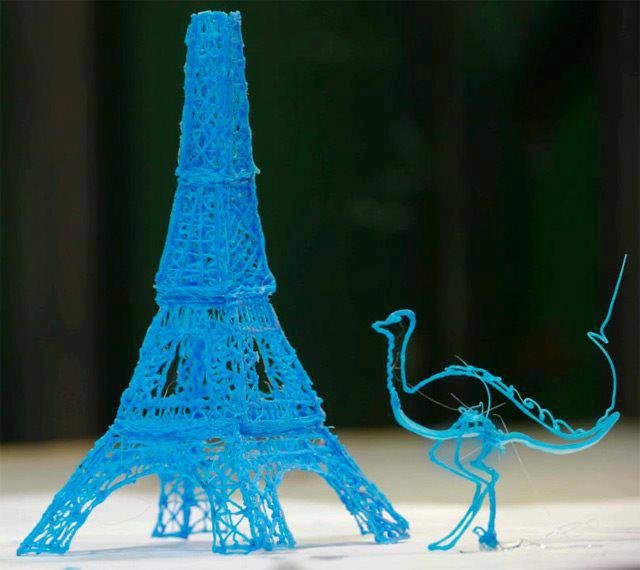
Forget those pesky 3D printers that require software and the knowledge of 3D modeling and behold the 3Doodler, the world’s first pen that draws in three dimensions in real time. Imagine holding a pen and waving it through the air, only the line your pen creates stays frozen, suspended and permanent in 3D space.Well it certainly looks like it, watch the video above to see the thing in action. The 3Doodler was designed by Boston-based company WobbleWorks who recently launched a Kickstarter campaign to sell the miraculous little devices that utilizes a special plastic which is heated and instantly cooled to form solid structures as you draw. I don’t know about you but for me this might have just won the most impulsive Kickstarter purchase in history.
 The World’s First 3D Printing Pen that Lets you Draw Sculptures

Forget those pesky 3D printers that require software and the knowledge of 3D modeling and behold the 3Doodler, the world’s first pen that draws in three dimensions in real time. Imagine holding a pen and waving it through the air, only the line your pen creates stays frozen, suspended and permanent in 3D space. Sound like magic? Well it certainly looks like it, watch the video in the given link to see the thing in action. The 3Doodler was designed by Boston-based company WobbleWorks who recently launched a Kickstarter campaign to sell the miraculous little devices that utilizes a special plastic which is heated and instantly cooled to form solid structures as you draw. I don’t know about you but for me this might have just won the most impulsive Kickstarter purchase in history. 
3Doodler is the world’s first and only 3D Printing Pen. Using ABS plastic (the material used by many 3D printers), 3Doodler draws in the air or on surfaces. It’s compact and easy to use, and requires no software or computers. You just plug it into a power socket and can start drawing anything within minutes.
 As 3Doodler draws, it extrudes heated plastic, which quickly cools and solidifies into a strong stable structure. This allows you to build an infinite variety of shapes and items with ease! Most people will instantly be able to trace objects on paper, and after only a few hours of practice you will be able to make far more intricate objects.

3Doodler works on almost any surface, including plastic, allowing users to personalize items such as iPhone cases, or anything else they feel like 3Doodling on. 3Doodler can even be used for minor repair work.

World's first bionic man worth $1 mn


 The world's first bionic man Rex, created using nearly $1 million-worth of state-of-the-art limbs and organs - synthetic blood from Sheffield University, prosthetic legs and ankle from MIT, retinas from Oxford University, artificial kidneys, pancreas and spleensfrom University College London and artificial lungs from Swansea was unveiled at London's Science Museum on Thursday.
'Rex', a two metre tall artificial human, is displayed at the Science Museum in central London on February 5, 2013. The British robotics designers claim it is the world's first completebionic man, featuring artificial organs as well as fully functioning limbs. It will be on public display until March 11.
Rex is a mixture of Robocop and Frankenstein, Rex - who has the face of a man is 6.5-feet tall with striking brown eyes.
He was jointly built with the help of over 18 companies and universities and for the first time gives tangible hope that replacing body parts with man-made alternatives can finally be possible.
The 640,000 GBP (1 million US dollars) humanoid has a distinctly human shape and boasts prosthetic limbs, a functional artificial blood circulatory system complete with artificial blood, as well as an artificial pancreas, kidney, spleen and trachea. Rex has a distinctly human shape and boasts prosthetic limbs.

In the two centuries since Mary Shelley's Dr Frankenstein brought a 'monster' to life, the subject has fascinated science fiction in books, comics, film and TV. Now research on advanced prosthetic arms and legs, as well as artificial eyes, hearts, lungs - and even hybrids between computer chips and living brains - means that scientists are finally able to replace body parts and even improve on human abilities.
The project involves Bertolt Meyer, a social psychologist from Switzerland who has a bionic hand himself. He met scientists working at the cutting edge of research to find out just how far this new technology can go.
Bertolt has had prosthetic hands since he was a child. His new £30,000 bionic hand, which can grasp and twist, is the most advanced on the market. But technology is moving so fast that Bertolt's bionic hand could soon be obsolete.
A far more advanced arm is being developed, the product of more than $100 million-worth of research into bionic limbs, funded by the US military. Bertolt visited Michael McLoughlin at Johns Hopkins University's Applied Physics Laboratory to try out the latest prototype - the Modular Prosthetic Limb (MPL).


Google Vision Glasses Concept

Google is working on a project Google vision Glasses..........
The idea is to the user wears a small single glass lens over an eye, affixed with a transparent screen and a camera, presumably connected via Bluetooth (or some futuristic version of the same) to a phone (or an implant) near the wearer. It’s an idea that has been floating around for decades, but Google’s teaser video on Google+ has confirmed its existence, or at least an intention. There is no working prototype to speak of, other than examples of what the eye-wear could look like, but the idea has been planted, and that’s good enough.
The video shows how the vision glasses works....
It has the classical Android buttons on the edge, at the back of the head and a camera discretely attached near the lens. It’s a straight design with tubular shapes linked to each other seamlessly. This headset with glasses is able to take pics using an UI similar to the one in Android 4.0 and it also comes with voice command and GPS tracking.
You get Google Maps and the latest emails and Google+ social stats straight to your eyeballs, an interesting feat, as well as the display of the album covers when you listen to music. I wonder how much this invention would impair the user and how much it will affect interacting with the real world… I’m pretty sure Google will reveal something soon concerning their plans for the real Glass project.


Audi Avatar 3-Seater Electric Supercar for 2032

 The Audi Avatar is a 3-seater electric supercar concept specially designed for the drivers of 2032 to enjoy the pleasure of driving that they experienced playing racing games during their childhood days. The appearance of the car is much identical with the science fiction flying cars we used to watch. This futuristic car concept features 4 extremely powerful in-wheel electric motors powered by supercharge-ion batteries. The ultra lightweight aerodynamic body along with the powerful backend, it can accelerate from 0 to 100 km/h in just 2.9 seconds and can achieve the top speed of over 360km/h with responsive handling.

 The exterior design of the car is inspired by the form of fabric blown in the wind. The form also carries traces of the historical Auto Union Type C Streamline race.
There are no conventional doors on the car, but instead, inspired by the jet fighters, there are three glass canopies. The main canopy opens forward together with the steering wheel and the dashboard; the two passengers’ canopies open backwards; and a side panel on the bodywork opens downwards to act as a step, making the event of getting in and out of the cockpit very special and easy.
 The interior is simply one continuous sheet, starting from the dashboard, then being folded and bended to create floor carpet and seat.
The interior of the car is as simple and futuristic as the exterior. Single sheet transparent LCD dashboarddisplays all the essential data such as speed and mileage. The screen in the center of the steering wheel displays digital map. The information can also be projected on the canopy by a head up display. The
whole driving experience would be like flying a fighter jet. There is a small but handy luggage space behind the driver seat for handbags and suitcases. It is also an arm rest for the passengers.


Four wheels are housed inside the car’s four “legs”. Each wheel contains an Audi In-wheel Electric Drive Unit, making the car an evolution in Audi’s trademark “Quattro” all time four-wheel-drive system. The long range Supercharge-ion battery which powers the in-wheel motors are separated into two packs located in front of as well as behind the cockpit, creating a perfect 50:50 weight distribution of the car for excellent handling.

Specifications
Length: 4480 mm
Width: 1900 mm
Height: 1060 mm
Wheel base; 3048 mm
Weight: 800 kg
En Engine: 4 Audi In-wheel Electric Drive Units
Power: 544 hp (4 X 100 kW)
Torque: 4500 Nm (3319.03 lb-ft)
0-100km: 2.9 s
Top Speed: 360 km/h

Color Picking Pen


 Korean designer jinsu park designed a concept pen that adopts the eyedropper tool of photoshop for real life. the color picker pen enables colors in the environment to be scanned and instantly used for drawing. the sensor detects the color and matches it to the color display. then the RGB cartridge located within the pen mixes the inks together to create the color that has been scanned

Park has designed a concept pen that adapts Photoshop's eyedropper tool for real life. On one end of the pen is a camera that captures a complex, real world color. Then, like an inkjet printer, a computer in the pen calculates the mixture of red, green and blue ink needed to replicate the color photographed by the camera. Ink in the perfect proportions then flows out of the ball point on the other end of the pen.

 Currently, the device is more fanciful than practical--Park could start refining it toward a working prototype by first including CMYK inks instead of RGB. But as computing continues to shrink in size and price, you can bet that Park and other designers will continue to erase the line between digital and physical artist tools.

ARTIFICIAL EYE/ RETINAL PROSTHESIS COULD HELP THE BLIND SEE AGAIN

Shawn Kelly, a senior systems scientist at Carnegie Mellon University, has developed a computer chip that translates camera images into electrical pulses that the nerves inside the brain can understand. The result is vision.

The cameras are incredibly small and mounted to a pair of glasses. The digital information picked up from t
he camera is sent along a wire to a thin film surgically implanted in the back of the patient's eye, between the sclera and the retina. The electrical signals stimulate the nerves in the retina, and that allows the patient to see. The system is powered via induction -- not much current is necessary since the electric field doesn't have to penetrate far into the head.


World’s Largest Building

 World’s Largest Building
For decades, the Pentagon has had the distinction of being the world’s largest building, but that is about to change . . .
Let me introduce to you Crystal Island, soon to be located in Moscow, Russia. This building is not just big, it’s enormous!
 This building, according to Nubricks, “will cover a staggering 2,670,000 square meters, stand 450 meters tall and will cost an estimated $4 billion.” Additionally, it is slated to have “3000 hotel rooms, 900 serviced apartments, a business centre, office spaces, a sports centre, entertainment centre and shopping mall as well as an international school, restaurants and cafes. Visitor numbers are expected to be high and there is a planned 16,500 space car park to accommodate them.”
From the look of the plans above, it appears that planners have taken into account solar and wind power, and have focused on keeping the design environmentally friendly in many other ways as well.
It looks like the rest of the world has returned to a battle for skyscraper supremacy – a battle the USA doesn’t quite have the funds to get involved in – anyone see the new Freedom Tower in NYC? I know I don’t! Maybe China and the Middle East can spare a few more dimes to help the poor old US of A out . . . again.
One thing is certain, Crystal Island will put Moscow back on the map as an architectural hub, something it hasn’t been since the rise of Red Square.

Water Droplet Resort

Based on an innovative concept ‘Water Droplet resort’ is an architectural marvel that has been designed in the shape of water drop by Orlando De Urrutia. It is the first building of its type which converts air into water with the help of solar power. It sounds unbelievable or magic but is true! The concept to design the building is nothing but a combination of technology and nature.
 Inspired by the form of a drop of water falling from the heights, the building is projected and thought to create conscience of the water. Designed for construction in warm and humid coasts, the Water Building Resort, will house an aquarium, Restaurant, Gyms, Hotel, Spa services, Convention Halls and Conference rooms. Moreover, the bottom floor of this resort complex will have a water treatment zone for purifying rain water and salty sea water and a technological investigation center to control and verify water quality. The building also incorporates a technology research center (Cidemco) which controlled certification of quality industrial products.


The building design allows the integration of renewable energy uptake and energy optimization. The sun-facing facade is covered with photovoltaic crystals latest technology that allows transparency and
energy to capture the electricity of the building. The facade opposite the sun are shutters that allow air
to enter which is conducted through the water producing equipment. The air passing
 through the central courtyard is speeding up and out the upper wind turbine, generating electricity for all teams abasteceder.
 Water Building Resort, will be the first build in the world that transform the air into water, starting to obtain water from the air it seems to science fiction, however it is a reality thanks to new technology and modern TeexMicron incorporated in this building.
 Their production based on the condensation of the humidity that is in the air, its location in the water of the sea, add a big value regarding a bigger condensation. Allowing to take advantage of the night daily evaporation and condensation.

Moreover, Building Water Resort recycles water from rain and purging with marine desalination equipment incorporated in the base of the building. Water generators “TeexMicron” capable of producing 5,000 liters of water per volume of 21.17 m3 team, 48 people, for the calculations we use an average of 105 liters per person.